

Week 6 Exercises
1. Pacifica Industrial Products Corporation makes two products, Product H and Product L. Product H is expected to sell 49,000 units next year and Product L is expected to sell 9,800 units. A unit of either product requires 0.6 direct labor-hours.
The company’s total manufacturing overhead for the year is expected to be $2,998,800.
Required:
- 1-a. The company currently applies manufacturing overhead to products using direct labor-hours as the allocation base. If this method is followed, how much overhead cost per unit would be applied to each product?
- 1-b. Compute the total amount of overhead cost that would be applied to each product.
- 2. Management is considering an activity-based costing system and would like to know what impact this change might have on product costs. For purposes of discussion, it has been suggested that all of the manufacturing overhead be treated as a product-level cost. The total manufacturing overhead would be divided in half between the two products, with $1,499,400 assigned to Product H and $1,499,400 assigned to Product L.If this suggestion is followed, how much overhead cost per unit would be assigned to each product?
Complete this question by entering your answers in the tabs below.
Required 1A
The company currently applies manufacturing overhead to products using direct labor-hours as the allocation base. If this method is followed, how much overhead cost per unit would be applied to each product?
Note: Round your answers to 2 decimal places.

Required 1B
Compute the total amount of overhead cost that would be applied to each product.

Required 2
Management is considering an activity-based costing system and would like to know what impact this change might have on product costs. For purposes of discussion, it has been suggested that all of the manufacturing overhead be treated as a product-level cost. The total manufacturing overhead would be divided in half between the two products, with $1,499,400 assigned to Product H and $1,499,400 assigned to Product L.
If this suggestion is followed, how much overhead cost per unit would be assigned to each product?
Note: Round your answers to 2 decimal places.

2. Sultan Company uses an activity-based costing system. At the beginning of the year, the company made the following estimates of cost and activity for its five activity cost pools:
| Activity Cost Pool | Activity Measure | Expected Overhead Cost | Expected Activity |
|---|---|---|---|
| Labor-related | Direct labor-hours | $ 317,600 | 39,700 DLHs |
| Purchase orders | Number of orders | $ 9,900 | 220 orders |
| Parts management | Number of part types | $ 67,890 | 93 part types |
| Board etching | Number of boards | $ 76,000 | 1,900 boards |
| General factory | Machine-hours | $ 237,600 | 21,600 MHs |
Required:
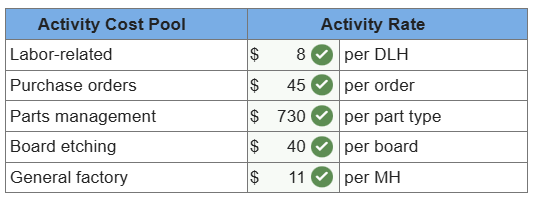
- Compute the activity rate for each of the activity cost pools.
- The expected activity for the year was distributed among the company’s four products as follows:
| Activity Cost Pool | Expected Activity | |||
|---|---|---|---|---|
| Product A | Product B | Product C | Product D | |
| Labor-related (DLHs) | 6,300 | 23,700 | 4,600 | 5,100 |
| Purchase orders (orders) | 70 | 27 | 40 | 83 |
| Parts management (part types) | 28 | 13 | 32 | 20 |
| Board etching (boards) | 580 | 700 | 620 | 0 |
| General factory (MHs) | 3,900 | 8,900 | 3,500 | 5,300 |
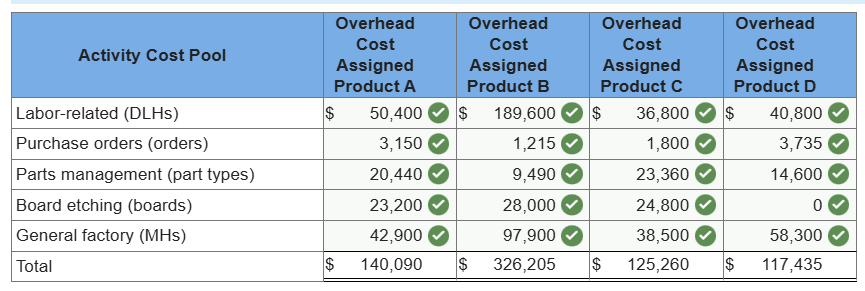
Using the ABC data, determine the total amount of overhead cost assigned to each product.
Complete this question by entering your answers in the tabs below.
Required 1
Compute the activity rate for each of the activity cost pools.
Using the ABC data, determine the total amount of overhead cost assigned to each product.
3. Quality Brick Company produces bricks in two processing departments—Molding and Firing. Information relating to the company’s operations in March follows:
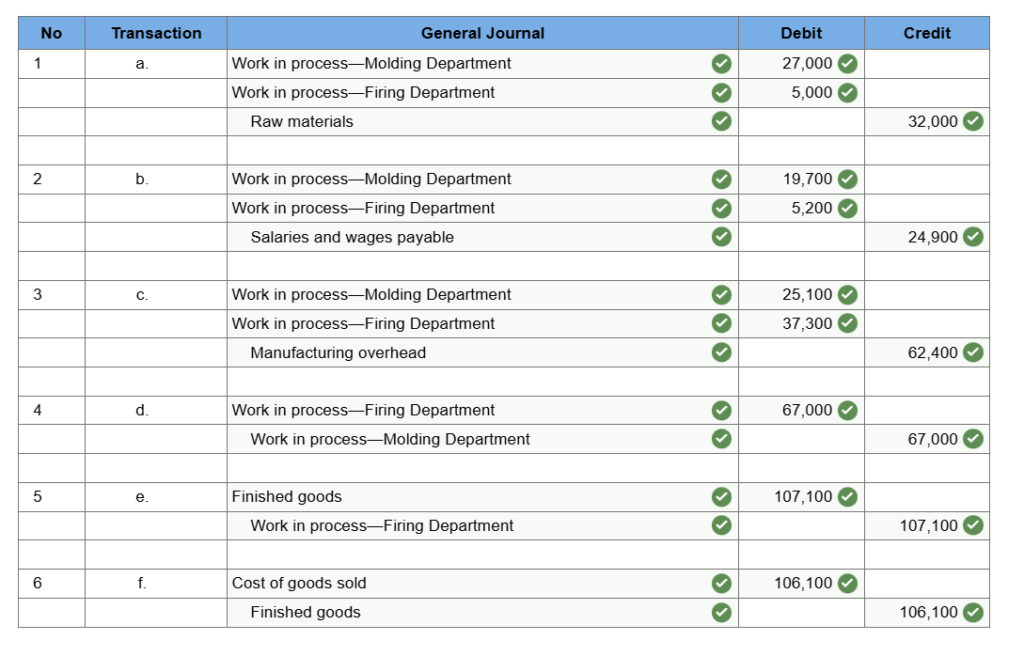
- Raw materials used in production: Molding Department, $27,000; and Firing Department, $5,000.
- Direct labor costs: Molding Department, $19,700; and Firing Department, $5,200.
- Manufacturing overhead was applied: Molding Department, $25,100; and Firing Department, $37,300.
- Unfired, molded bricks were transferred from the Molding Department to the Firing Department. The cost of the unfired, molded bricks was $67,000.
- Finished bricks were transferred from the Firing Department to the finished goods warehouse. The cost of the finished bricks was $107,100.
- Finished bricks were sold to customers. The cost of the finished bricks sold was $106,100.
Required:
Prepare journal entries to record items (a) through (f) above.
Note: If no entry is required for a transaction/event, select “No journal entry required” in the first account field. Use a compound journal entry as needed for each transaction.
4. Clonex Labs, Incorporated, uses the weighted-average method of process costing. The following data are available for one department for October:
| Units | Percent Completed | ||
|---|---|---|---|
| Materials | Conversion | ||
| Work in process, October 1 | 55,000 | 90% | 65% |
| Work in process, October 31 | 37,000 | 67% | 48% |
The department started 393,000 units into production during the month and transferred 411,000 completed units to the next department.
Required:
Compute the equivalent units of production for October.

5. Superior Micro Products uses the weighted-average method of process costing. Data for the Assembly Department for May appear below:
| Materials | Labor | Overhead | |
|---|---|---|---|
| Work in process, May 1 | $ 11,600 | $ 17,361 | $ 80,664 |
| Cost added during May | $ 70,450 | $ 11,574 | $ 53,776 |
| Equivalent units of production | 1,000 | 900 | 800 |
Required:
Compute the cost per equivalent unit for materials, labor, overhead, and in total.
Note: Round your answers to 2 decimal places.

6. Data concerning a recent period’s activity in the Prep Department, the first processing department in a company that uses process costing, appear below:
| Materials | Conversion | |
|---|---|---|
| Equivalent units in ending work in process inventory | 2,170 | 890 |
| Cost per equivalent unit | $ 14.76 | $ 5.33 |
A total of 21,000 units were completed and transferred to the next processing department during the period.
Required:
- Compute the cost of ending work in process inventory for materials, conversion, and in total.
- Compute the cost of the units completed and transferred out for materials, conversion, and in total.
Note: For all requirements, round your final answers to the nearest whole dollar amount.

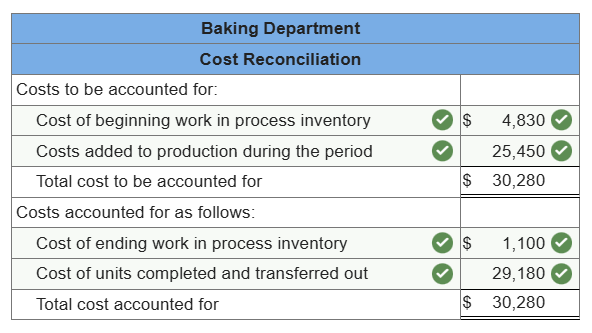
7. Maria Am Corporation uses the weighted-average method of process costing. The Baking Department is one of the processing departments in its strudel manufacturing facility. In June in the Baking Department, the cost of beginning work in process inventory was $4,830, the cost of ending work in process inventory was $1,100, and the cost added to production was $25,450.
Required:
Prepare a cost reconciliation report for the Baking Department for June.
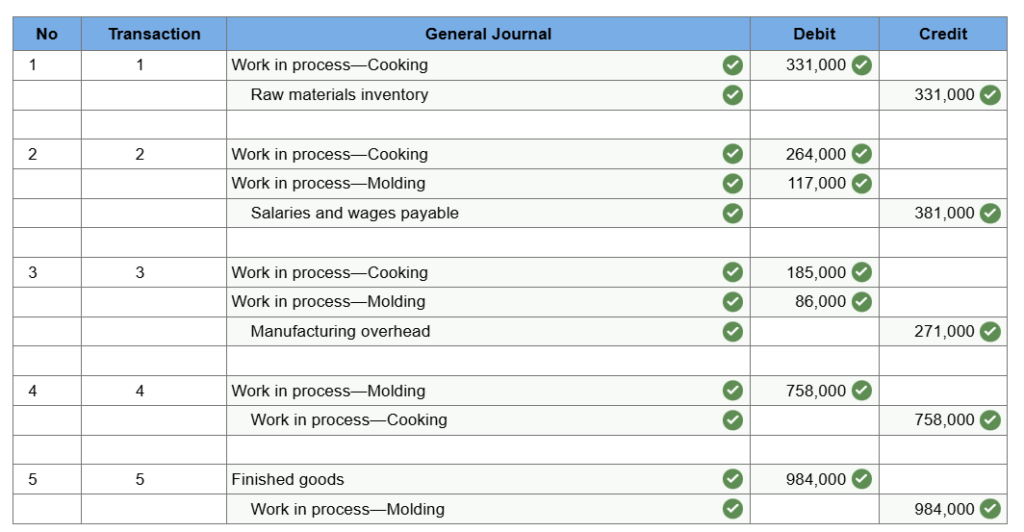
8. Chocolaterie de Geneve, SA, is located in a French-speaking canton in Switzerland. The company makes chocolate truffles that are sold in popular embossed tins. The company has two processing departments—Cooking and Molding. In the Cooking Department, the raw ingredients for the truffles are mixed and then cooked in special candy-making vats. In the Molding Department, the melted chocolate and other ingredients from the Cooking Department are carefully poured into molds and decorative flourishes are applied by hand. After cooling, the truffles are packed for sale. The company uses a process costing system. The T-accounts below show the flow of costs through the two departments in April:
| Debit | Credit | ||
|---|---|---|---|
| Balance 4/1 | 11,000 | Transferred out | 758,000 |
| Direct materials | 331,000 | ||
| Direct labor | 264,000 | ||
| Overhead | 185,000 | ||
| Debit | Credit | ||
|---|---|---|---|
| Balance 4/1 | 20,000 | Transferred out | 984,000 |
| Transferred in | 758,000 | ||
| Direct labor | 117,000 | ||
| Overhead | 86,000 | ||
Required:
Prepare journal entries showing the flow of costs through the two processing departments.
Note: If no entry is required for a transaction/event, select “No journal entry required” in the first account field.
9. Helix Corporation uses the weighted-average method of process costing. It produces prefabricated flooring in a series of steps carried out in production departments. All of the material used in the first production department is added at the beginning of processing in that department. Data for May for the first production department follow:
| Units | Percent Complete | ||
|---|---|---|---|
| Materials | Conversion | ||
| Work in process inventory, May 1 | 55,000 | 100% | 40% |
| Work in process inventory, May 31 | 35,000 | 100% | 25% |
| Materials cost in work in process inventory, May 1 | $ 47,100 |
|---|---|
| Conversion cost in work in process inventory, May 1 | $ 12,900 |
| Units started into production | 247,500 |
| Units transferred to the next production department | 267,500 |
| Materials cost added during May | $ 64,825 |
| Conversion cost added during May | $ 186,000 |
Required:
For May:
Compute the first production department’s cost of the units transferred to the next production department for materials, conversion, and in total.
Calculate the first production department’s equivalent units of production for materials and conversion.
Compute the first production department’s cost per equivalent unit for materials and conversion.
Compute the first production department’s cost of ending work in process inventory for materials, conversion, and in total.
Required 1
Calculate the first production department’s equivalent units of production for materials and conversion.

Required 2
Compute the first production department’s cost per equivalent unit for materials and conversion.
Note: Round your answers to 2 decimal places.

Required 3
Compute the first production department’s cost of ending work in process inventory for materials, conversion, and in total.
Note: Round your intermediate calculations to 2 decimal places.

Required 4

10. Helix Corporation uses the weighted-average method of process costing. It produces prefabricated flooring in a series of steps carried out in production departments. All of the material used in the first production department is added at the beginning of processing in that department. Data for May for the first production department follow:
| Units | Percent Complete | ||
|---|---|---|---|
| Materials | Conversion | ||
| Work in process inventory, May 1 | 5,000 | 100% | 40% |
| Work in process inventory, May 31 | 10,000 | 100% | 30% |
| Materials cost in work in process inventory, May 1 | $ 1,500 |
|---|---|
| Conversion cost in work in process inventory, May 1 | $ 4,000 |
| Units started into production | 180,000 |
| Units transferred to the next production department | 175,000 |
| Materials cost added during May | $ 54,000 |
| Conversion cost added during May | $ 352,000 |
Required:
For May:
Compute the first production department’s cost of the units transferred to the next production department for materials, conversion, and in total.
Calculate the first production department’s equivalent units of production for materials and conversion.
Compute the first production department’s cost per equivalent unit for materials and conversion.
Compute the first production department’s cost of ending work in process inventory for materials, conversion, and in total.
Complete this question by entering your answers in the tabs below.
Required 1
Calculate the first production department’s equivalent units of production for materials and conversion.

Required 2
Compute the first production department’s cost per equivalent unit for materials and conversion.
Note: Round your answers to 2 decimal places.

Required 3
Compute the first production department’s cost of ending work in process inventory for materials, conversion, and in total.
Note: Round your intermediate calculations to 2 decimal places.

Required 4

Week 8 Exercises
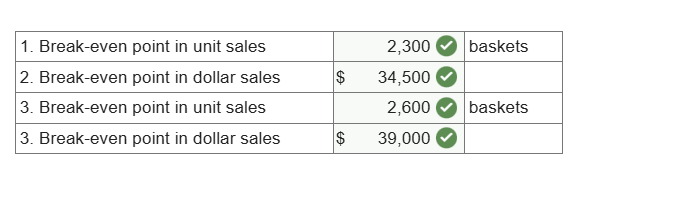
1. 2. Mauro Products sells a woven basket for $15 per unit. Its variable expense is $13 per unit and the company’s monthly fixed expense is $4,600.
Required:
- Calculate the company’s break-even point in unit sales.
- Calculate the company’s break-even point in dollar sales.Note: Do not round intermediate calculations.
- If the company’s fixed expenses increase by $600, what would become the new break-even point in unit sales? In dollar sales?Note: Do not round intermediate calculations.
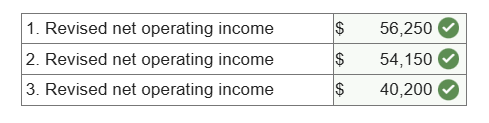
2. Whirly Corporation’s contribution format income statement for the most recent month is shown below:
| Total | Per Unit | |
|---|---|---|
| Sales (7,300 units) | $ 240,900 | $ 33.00 |
| Variable expenses | 131,400 | 18.00 |
| Contribution margin | 109,500 | $ 15.00 |
| Fixed expenses | 54,300 | |
| Net operating income | $ 55,200 |
Required:
(Consider each case independently):
What would be the revised net operating income per month if the sales volume is 6,300 units?
What would be the revised net operating income per month if the sales volume increases by 70 units?
What would be the revised net operating income per month if the sales volume decreases by 70 units?
3. Required information
[The following information applies to the questions displayed below.]
Karlik Enterprises distributes a single product whose selling price is $27 per unit and whose variable expense is $19 per unit. The company’s monthly fixed expense is $24,000.
2. Calculate the company’s break-even point in unit sales.

4. Miller Company’s contribution format income statement for the most recent month is shown below:
| Total | Per Unit | |
|---|---|---|
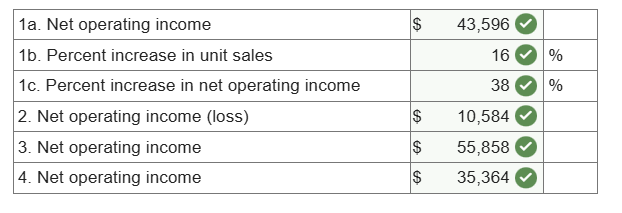
| Sales (21,000 units) | $ 189,000 | $ 9.00 |
| Variable expenses | 113,400 | 5.40 |
| Contribution margin | 75,600 | $ 3.60 |
| Fixed expenses | 44,100 | |
| Net operating income | $ 31,500 |
Required:
Required:
(Consider each of the four requirements independently):
Assume the sales volume increases by 3,360 units:
What is the revised net operating income?
What is the percent increase in unit sales?
Using the most recent month’s degree of operating leverage, what is the percent increase in net operating income?
What is the revised net operating income if the selling price decreases by $1.50 per unit and the number of units sold increases by 24%?
What is the revised net operating income if the selling price increases by $1.50 per unit, fixed expenses increase by $5,000, and the number of units sold decreases by 2%?
What is the revised net operating income if the selling price per unit increases by 10%, variable expenses increase by 20 cents per unit, and the number of units sold decreases by 12%?
5. Required information
[The following information applies to the questions displayed below.]
Jaffre Enterprises distributes a single product whose selling price is $10 per unit and whose variable expense is $5 per unit. The company’s fixed expense is $14,000 per month.
2. Calculate the company’s break-even point in unit sales.

6. Olongapo Sports Corporation distributes two premium golf balls—Flight Dynamic and Sure Shot. Monthly sales and the contribution margin ratios for the two products follow:
| Product | Total | ||
|---|---|---|---|
| Flight Dynamic | Sure Shot | ||
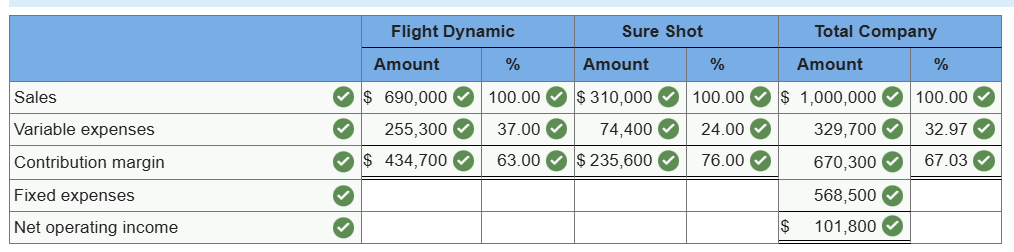
| Sales | $ 690,000 | $ 310,000 | $ 1,000,000 |
| CM ratio | 63% | 76% | ?question mark |
Fixed expenses total $568,500 per month.
Required:
If sales increase by $56,000 a month, by how much would monthly net operating income increase?
Prepare a contribution format income statement for the company as a whole.
What is the company’s break-even point in dollar sales based on the current sales mix?
Complete this question by entering your answers in the tabs below.
Required 1
Prepare a contribution format income statement for the company as a whole.
Note: Round your percentage answers to 2 decimal places (i.e. 0.1234 should be entered as 12.34).
Required 2
What is the company’s break-even point in dollar sales based on the current sales mix?
Note: Do not round intermediate calculations. Round your answer to the nearest whole dollar amount.

Required 3
If sales increase by $56,000 a month, by how much would monthly net operating income increase?
Note: Do not round intermediate calculations. Round your answer to the nearest whole dollar amount.

7. Wingate Company, a wholesale distributor of electronic equipment, has been experiencing losses as shown by its most recent monthly contribution format income statement:
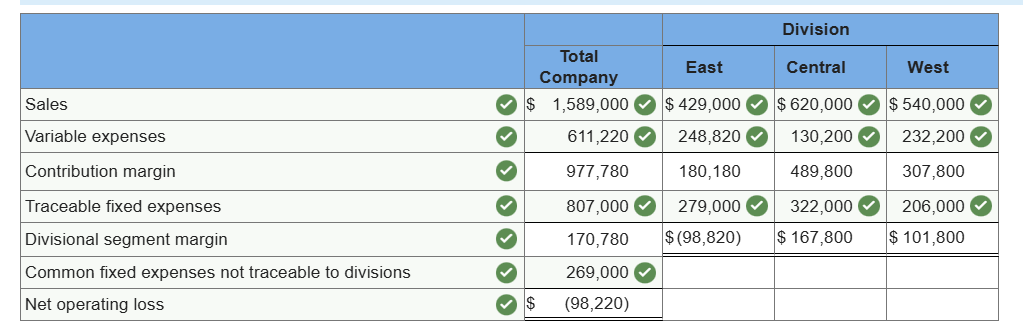
| Sales | $ 1,589,000 |
|---|---|
| Variable expenses | 611,220 |
| Contribution margin | 977,780 |
| Fixed expenses | 1,076,000 |
| Net operating income (loss) | $ (98,220) |
In an effort to resolve the problem, the company wants to prepare an income statement segmented by division. Accordingly, the Accounting Department provided the following information:
| Division | |||
|---|---|---|---|
| East | Central | West | |
| Sales | $ 429,000 | $ 620,000 | $ 540,000 |
| Variable expenses as a percentage of sales | 58% | 21% | 43% |
| Traceable fixed expenses | $ 279,000 | $ 322,000 | $ 206,000 |
Required:
2-b. Would you recommend the increased advertising?
1. Prepare a contribution format income statement segmented by divisions.
2-a. The Marketing Department believes increasing the West Division’s monthly advertising by $24,000 will increase that division’s sales by 13%. Assuming these estimates are accurate, how much would the company’s net operating income increase (decrease) if the proposal is implemented?
Complete this question by entering your answers in the tabs below.
Required 1
Prepare a contribution format income statement segmented by divisions.
Required 2A
The Marketing Department believes increasing the West Division’s monthly advertising by $24,000 will increase that division’s sales by 13%. Assuming these estimates are accurate, how much would the company’s net operating income increase (decrease) if the proposal is implemented?
Note: Do not round intermediate calculations.

Required 2B
Would you recommend the increased advertising?

8. Whitman Company has just completed its first year of operations. The company’s absorption costing income statement for the year follows:
| Whitman Company Income Statement | |
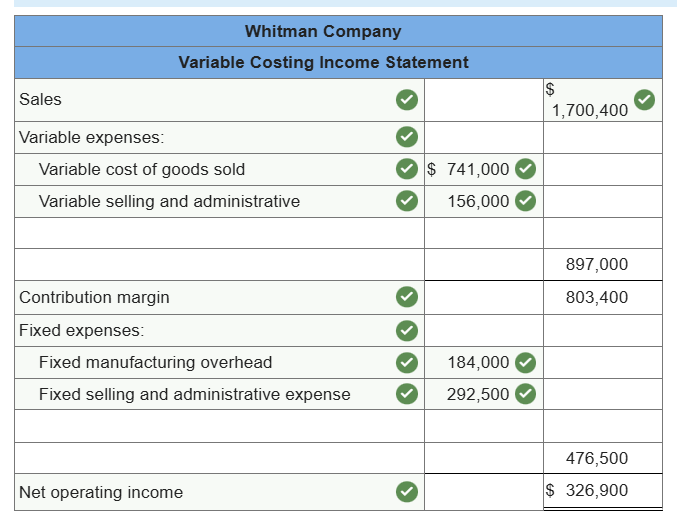
| Sales (39,000 units × $43.60 per unit) | $ 1,700,400 |
|---|---|
| Cost of goods sold (39,000 units × $23 per unit) | 897,000 |
| Gross margin | 803,400 |
| Selling and administrative expenses | 448,500 |
| Net operating income | $ 354,900 |
The company’s selling and administrative expenses consist of $292,500 per year in fixed expenses and $4 per unit sold in variable expenses. The $23 unit product cost given above is computed as follows:
| Direct materials | $ 11 |
|---|---|
| Direct labor | 5 |
| Variable manufacturing overhead | 3 |
| Fixed manufacturing overhead ($184,000 ÷ 46,000 units) | 4 |
| Absorption costing unit product cost | $ 23 |
Required:
Reconcile any difference between the net operating income on your variable costing income statement and the net operating income on the absorption costing income statement above.
Redo the company’s income statement in the contribution format using variable costing.
Complete this question by entering your answers in the tabs below.
Required 1
Redo the company’s income statement in the contribution format using variable costing.
Required 2
Reconcile any difference between the net operating income on your variable costing income statement and the net operating income on the absorption costing income statement above.
Note: Enter any losses or deductions as a negative value.

9. Walsh Company manufactures and sells one product. The following information pertains to each of the company’s first two years of operations:
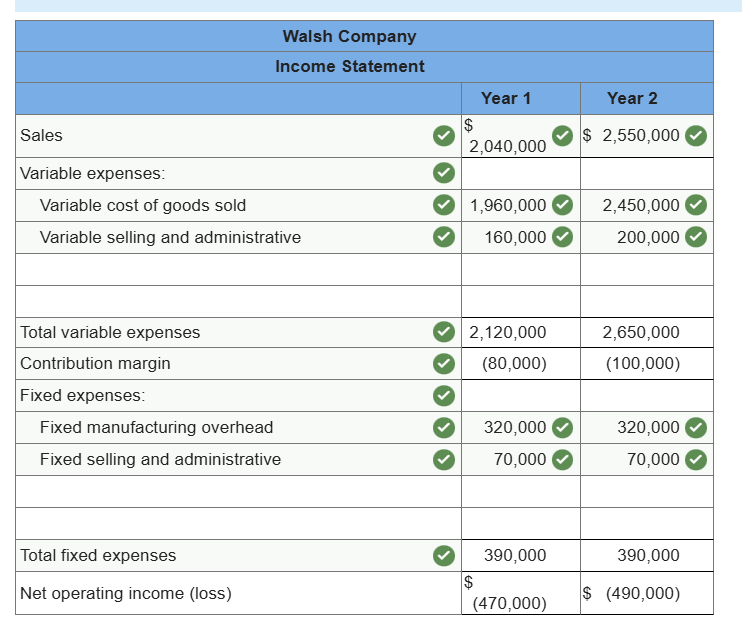
| Variable costs per unit: | |
| Manufacturing: | |
| Direct materials | $ 27 |
|---|---|
| Direct labor | $ 17 |
| Variable manufacturing overhead | $ 5 |
| Variable selling and administrative | $ 4 |
| Fixed costs per year: | |
| Fixed manufacturing overhead | $ 320,000 |
| Fixed selling and administrative expenses | $ 70,000 |
During its first year of operations, Walsh produced 50,000 units and sold 40,000 units. During its second year of operations, it produced 40,000 units and sold 50,000 units. The selling price of the company’s product is $51 per unit.
Required:
Assume the company uses variable costing:
Compute the unit product cost for Year 1 and Year 2.
Prepare an income statement for Year 1 and Year 2.
Assume the company uses absorption costing:
Compute the unit product cost for Year 1 and Year 2.
Prepare an income statement for Year 1 and Year 2.
Reconcile the difference between variable costing and absorption costing net operating income in Year 1 and Year 2.
Complete this question by entering your answers in the tabs below.
Required 1A
Assume the company uses variable costing. Compute the unit product cost for year 1 and year 2.

Required 1B
Assume the company uses variable costing. Prepare an income statement for Year 1 and Year 2.
Required 2A
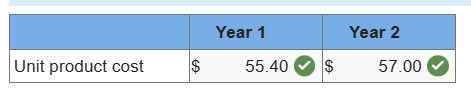
Assume the company uses absorption costing. Compute the unit product cost for Year 1 and Year 2.
Note: Round your answer to 2 decimal places.
Required 2B
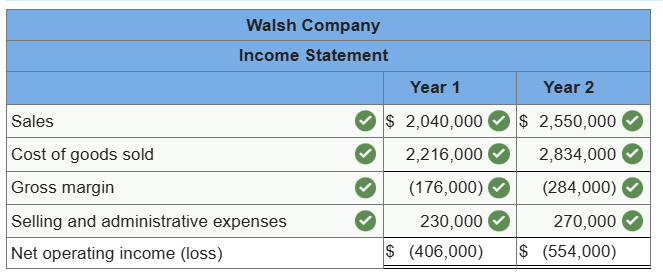
Assume the company uses absorption costing. Prepare an income statement for Year 1 and Year 2.
Note: Round your intermediate calculations to 2 decimal places.
Required 3
Reconcile the difference between variable costing and absorption costing net operating income in Year 1 and Year 2.
Note: Enter any losses or deductions as a negative value.

10. Piedmont Company segments its business into two regions—North and South. The company prepared the contribution format segmented income statement as shown:
| Total Company | North | South | |
|---|---|---|---|
| Sales | $ 937,500 | $ 750,000 | $ 187,500 |
| Variable expenses | 637,500 | 600,000 | 37,500 |
| Contribution margin | 300,000 | 150,000 | 150,000 |
| Traceable fixed expenses | 142,000 | 71,000 | 71,000 |
| Segment margin | 158,000 | $ 79,000 | $ 79,000 |
| Common fixed expenses | 62,000 | ||
| Net operating income | $ 96,000 |
Required:
- Compute the companywide break-even point in dollar sales.
- Compute the break-even point in dollar sales for the North region.
- Compute the break-even point in dollar sales for the South region.
Note: For all requirements, round your intermediate calculations to 2 decimal places. Round your final answers to the nearest dollar.
